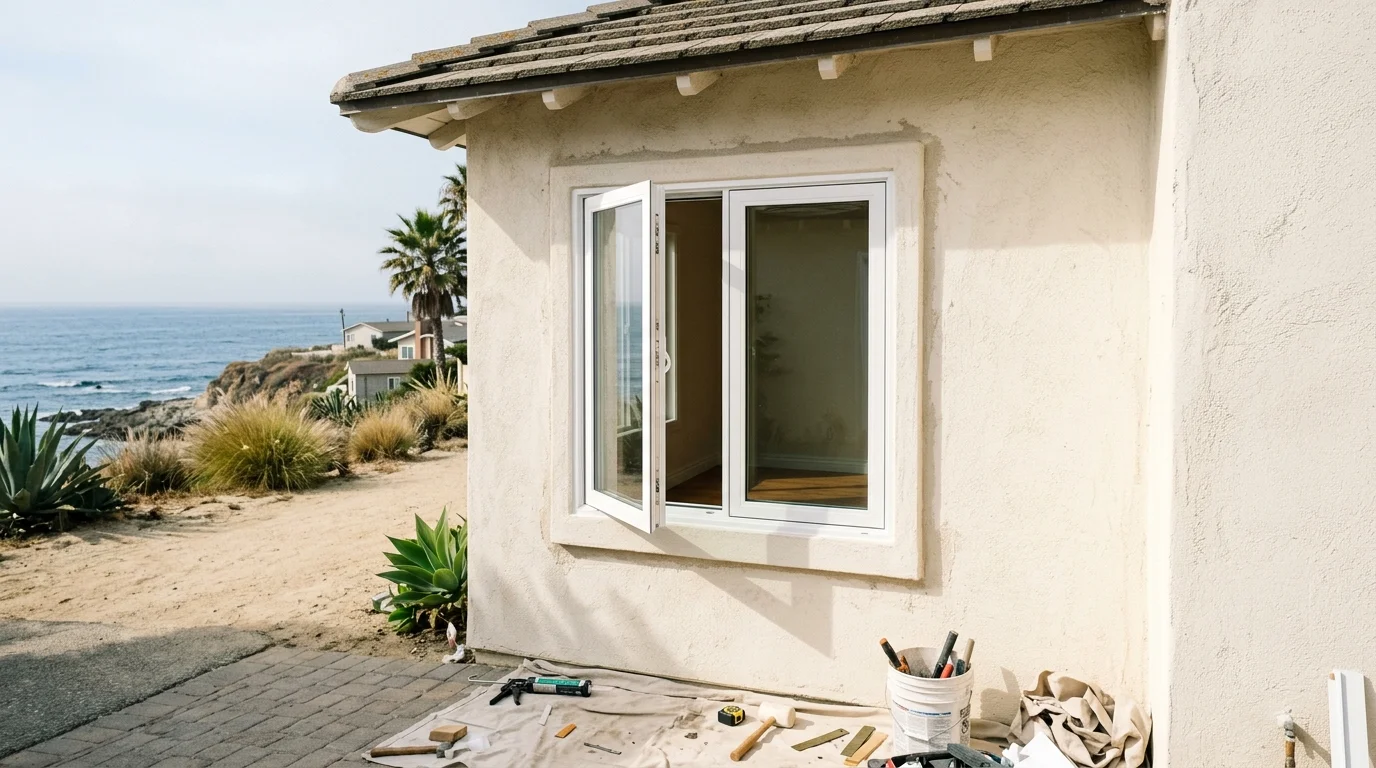
The crank on an Oceanside casement turns, and the sash does not move. Or the sash swings, then stops short of the lock. Those two failures look similar from the room. They are not the same repair. A licensed window pro has to see whether the handle, the operator, the arm, the lock, or the hinges gave out. Replacing the wrong piece leaves you with a window that still will not close.
A spinning crank and a sash that will not close are different jobs
A casement is hinged on one side and swings out like a small door. You turn a crank at the sill. That crank is only the handle. Under the cover sits the operator, a gearbox that turns your hand into a push or pull on a metal arm. The arm rides in a track on the sash. Hinges carry the weight. A lock on the side, sometimes called a fastener, pulls the sash tight once it is in.
If the handle spins with almost no resistance, the spline inside the handle is often worn, or the gears in the operator are stripped. You may hear a click or a grind. The sash stays put. A new handle will not fix a dead gearbox.
If the crank is stiff and the sash still will not seat, look at the lock first. A casement that is already latched will not pull in. If the lock is open and the sash still hangs off the weatherstrip, the operator may be working against a dropped sash or a bent arm.
A snapped handle is usually the last thing that broke, not the first. People crank harder when the sash binds. The plastic or zinc handle shears. Swap only the handle and the next one snaps too.
Handles are not one size. Spline shapes, stem lengths, folding or rigid cranks, and left or right handing all differ by maker and year. There is no universal crank on a hardware-store peg that fits every Oceanside vinyl casement. Photograph the handle on the window. Note whether the sash hinges left or right from inside. Keep the old piece for the pro. Ask for a written line item that names the handle, the operator, and any arm or lock, not a vague hardware charge.
This is not a slider that sticks in its track. It is not a hung window that will not stay open. Those posts cover different hardware. This page is for a casement that will not crank, latch, or pull shut.
Salt air on casement operators from Imperial Beach to Oceanside
Coastal casements fail at the gearbox. From Imperial Beach and Coronado up through Ocean Beach, Pacific Beach, La Jolla, Carlsbad, and Oceanside, salt sits on the operator cover and works into the worm gear. The arm pits. The track on the sash fills with grit. You crank, the gear slips, and the sash stays half open in a west wind.
Inland casements fail another way. In Escondido, San Marcos, Poway, and El Cajon, summer heat bakes the grease in the operator into a dry paste. The sash can also drop on tired hinges, so the lock no longer lines up. The crank still turns. The lock misses the strike.
A west-facing casement on an Oceanside stucco tract home works harder than a shaded east casement in Rancho Bernardo. More cycles. More sun on the vinyl. More salt on the sill. The operator is a small part in a wet, sandy slot. That is why coastal crank failures cluster on the ocean side of the house.
Do not soak the operator in household oil. Oil holds sand. Wipe visible grit from the track if you can reach it without forcing the sash. Stop if the crank spins freely or the arm has left the track. Forcing a bound sash bends the arm and strips what is left of the gears.
Window Pro SD does not repair hardware. We match you with a licensed independent pro who does. Glazing work in California falls inside the C-17 scope in Cal. Code Regs. tit. 16, sec. 832.17. That section covers selecting, assembling, and installing glass, frames, panels, sashes, and doors. Confirm the pro’s license on the CSLB license check before anyone opens the operator. California Business and Professions Code section 7048 requires a contractor license when the aggregate contract price for labor, materials, and all other items is $1,000 or more.
What the pro replaces: operator, arm, and lock
The useful visit is a diagnosis, not a handle swap. The pro should show you three things on the sill before ordering parts.
The operator. That is the gearbox under the crank cover. If the handle turns and the arm does not, the operator is the usual failure. Coastal units often come out as a whole assembly because the worm and the housing have both corroded.
The arm and track. Dual-arm and split-arm operators are common on wider sashes. If the arm has popped out of the track, or the track is bent, a new operator on a bad track will fail again. The pro should say whether the arm, the track shoe, and the operator are one kit or separate line items.
The lock, or fastener. That is the latch on the side of the sash that pulls the sash against the frame. A sash that cranks almost shut but will not lock is often a lock-and-strike alignment problem, not a dead crank. Sagging hinges throw that alignment off. Tightening a lock against a dropped sash cracks the strike.
Ask for the written line item to name each piece. Hardware matches vary by brand, color, handing, and year. A spec that is not on a written quote is not a spec you can check. We do not publish part numbers or a brand hardware price here. The figure that matters is the one on your quote, with the operator, arm, and lock listed.
If the sash still has sound glass, a square frame, and intact weatherstrip, hardware-only window repair is the usual path. The pro should also check the cover and the folding handle. Those are finish parts. They do not move the sash.
When the hinge or sash is the real problem
Hinges carry the sash. The operator only pushes it. When the bottom hinge sags, the sash drops, the lock misses, and the weatherstrip drags. You feel that as a stiff crank. Keep turning and you chew the operator.
Look at the gap. On a healthy casement the space around the sash is even. A fat gap at the top latch side and a tight scrape at the sill means the sash has dropped. Paint ridges, swollen wood on an older coastal cottage, or a vinyl sash that has crept in heat can do the same thing.
Do not lift the sash with the crank. That is how arms bend. A pro can rehang or replace hinges, then set the lock. If the frame is racked, hinge work will not last. That is a unit conversation, not a crank conversation.
Wood casements in older Coronado and Ocean Beach cottages pick up moisture at the sill. The operator screws then pull out of soft wood. A new operator in the same holes backs out in a season. The pro should say whether the sill can take screws or whether the sash and frame are done.
Vinyl casements in 1980s and 1990s inland tracts, Escondido and San Marcos especially, more often show heat-dried grease and a sash that has settled. The glass can still be fine. The hardware is tired.
If you are choosing a style for a new opening, casement versus sliding is a separate decision. This post is about the casement you already have.
Repair the hardware or replace the casement unit
Keep the sash when the frame is square, the glass is clear, and the failure is the operator, arm, lock, or hinges. Replace the unit when the frame is rotten, the sash is racked, the insulated glass is fogged, or matching hardware is no longer made for that window.
Manufacturers still make casement windows. Crank operators are current hardware, not a leftover style. What goes out of production is a specific operator for a specific vinyl line from a specific year. If the pro cannot match the operator, the honest next step is a replacement sash or a full unit, not a close-enough gearbox that binds.
In the City of San Diego, window replacement needs a building permit. Same-size, same-type replacement can use a No-Plan Building Permit under Development Services Information Bulletin 203. That is a permit issued without plan review, not an exemption from permitting. A building 45 years or older, or a designated historic resource, triggers historic review unless the scope is exempt. Confirm current rules with City of San Diego Development Services. Oceanside, Encinitas, Escondido, and the unincorporated county each set their own permit rules. Ask that building department whether you are describing hardware-only work or a full unit.
If the opening is being replaced, San Diego County is Climate Zones 7 and 10. The 2025 Building Energy Efficiency Standards, in force January 1, 2026, set a prescriptive fenestration U-factor of 0.30 in those zones. The mandatory maximum is 0.40 in every climate zone. California Energy Code section 150.2(b) allows replacing up to 75 square feet of vertical fenestration at U-0.40, with SHGC no greater than 0.35 in the zones that include this county. Confirm the current edition with the building department. The 150.2(b) text cited here was read from the 2022 edition.
Whole-window replacement in a pre-1978 home is a renovation under EPA’s Lead Renovation, Repair, and Painting Rule (40 CFR 745.83). The minor-repair exemption does not include window replacement. Replacing a pane of glass or fixing a broken window balancer is not window replacement for RRP, though painted-surface work can still be covered. Ask the pro whether painted surfaces will be disturbed, and to keep any test records.
A single casement can go in as a retrofit insert or a full-frame unit. Style options live on our sliding, casement, and double-hung service page. The quote should say which path, and why.
When to call us
When the crank spins, the handle has snapped, or the sash will not latch, you want a licensed window contractor looking at the operator. Call us at (858) 400-6418 and we’ll connect you with a licensed local window contractor.