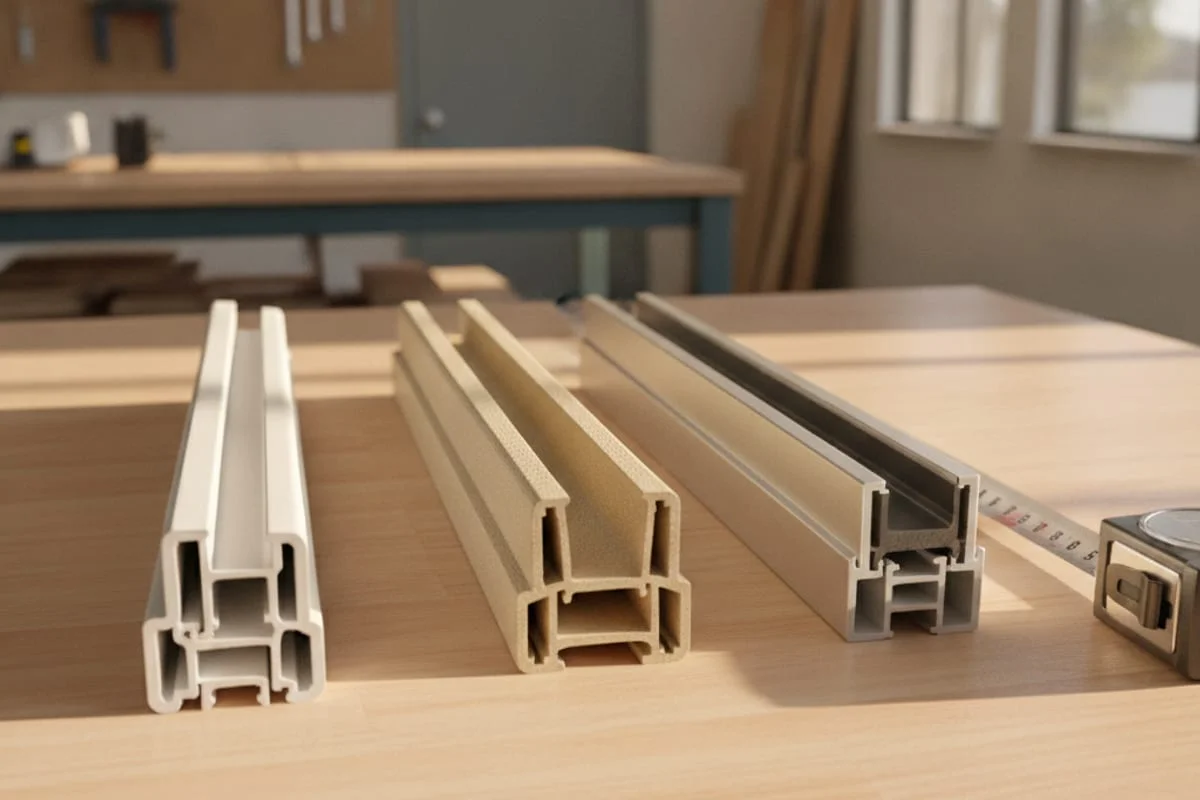
The frame material question every San Diego homeowner faces
When you start getting window replacement quotes, you will hear three frame materials over and over: vinyl, fiberglass, and aluminum. Every salesperson has a reason their preferred material is the right call for your home. The honest answer depends on where your home sits in the county, what your budget is, and what you are trying to solve.
San Diego’s climate is not uniform. A 1,900 square foot home in Cardiff-by-the-Sea deals with daily salt air, marine layer humidity, and moderate temperature swings. A similar home in El Cajon deals with dry heat, 110°F summer peaks, and cold winter nights. A condo in Mission Hills has lead-paint-era aluminum frames that need an exact-size replacement. Each situation calls for a different answer.
This guide lays out how vinyl, fiberglass, and aluminum perform against the conditions that actually matter here.
Vinyl windows
Vinyl (PVC) windows are the dominant replacement choice in San Diego County and have been for 30 years. The reasons are real.
Vinyl does not conduct heat or cold as readily as aluminum, which means better thermal performance without a thermal break. It does not corrode in salt air, which matters in the beach communities from Oceanside down through Imperial Beach. It does not warp in the inland temperature swings the way wood does. And it costs less per window than fiberglass or wood, which matters on a full-house replacement of 12-16 windows.
The knock on vinyl is that it expands and contracts more than fiberglass with temperature changes. In most San Diego climates this does not matter much because the temperature range is moderate. In extreme east county locations with very hot summers and cold winters, the expansion cycling can work the seals over time, but it usually takes 20+ years to show up as a problem.
Vinyl also has more limited color options than other materials. Most vinyl windows come in white, tan, and sometimes a darker bronze. The interior and exterior color are the same material color, which limits customization. For a home in a neighborhood where exterior aesthetics matter, this can be a factor.
Best for: most San Diego homeowners replacing 1970s-1990s aluminum or single-pane wood windows on a mid-range budget. Nearly every home in Poway, Santee, Lakeside, Spring Valley, Chula Vista, and the inland tracts.
Typical installed cost on this site: vinyl retrofit about $650-$1,200 per window. Dual-pane insert $400-$900. Material-only vinyl on the service page is a different number; use the written installer quote.
Fiberglass windows
Fiberglass windows are made from pultruded fiberglass, the same material process used in electrical insulation and marine boat hulls. They are dimensionally stable in ways vinyl is not, and their thermal performance is excellent.
The practical advantages in San Diego are three: they do not expand and contract with temperature swings, they hold tight tolerances over decades, and they can be painted. An interior wood-grained fiberglass frame in a Craftsman bungalow in Normal Heights or South Park can match the original character without the maintenance of real wood.
Fiberglass also handles coastal salt air without corrosion. For high-end coastal homes in La Jolla, Del Mar, and Coronado, fiberglass gives you the durability of vinyl with the appearance flexibility closer to wood.
The trade-off is cost. Fiberglass usually prices above vinyl on the same opening. The site’s fiberglass material band is $600-$1,400 before install; vinyl material is $300-$800. Ask each bidder for installed numbers on the same openings instead of a whole-house adder invented here.
Best for: high-end coastal homes, historic neighborhoods where paint color matching matters, east county homes with extreme temperature cycling, or anyone willing to spend more for dimensional stability and custom color options.
Typical installed cost on this site: get a written quote. Fiberglass material is listed at $600-$1,400 per window before installation.
Aluminum windows
Aluminum was the default window material in California from the 1950s through the 1980s, and a lot of San Diego homes still have original aluminum single-pane sliding windows. As a replacement material, modern aluminum has a narrower use case than it did 40 years ago.
The issue is thermal conductivity. Aluminum conducts heat and cold much more readily than vinyl or fiberglass, which means the frame itself is a path for heat loss in winter and heat gain in summer. Modern aluminum windows address this with a thermal break, a layer of polyamide or polyurethane separating the interior and exterior aluminum sections. A thermally broken aluminum window performs meaningfully better than single-pane aluminum but still trails vinyl and fiberglass in whole-unit U-factor performance.
Where aluminum still makes sense: commercial-scale openings, large fixed-lite windows where the slim sightlines matter architecturally, and window walls in contemporary homes where the narrow aluminum profile is a design feature. Mid-century modern homes in Kensington, La Jolla Shores, and the canyon-adjacent neighborhoods of Normal Heights and University Heights are realistic candidates.
For standard residential replacement, aluminum is usually not the first choice on thermal grounds unless you are specifically trying to match existing aluminum frames in a historic building or HOA situation where the exterior appearance is constrained.
Best for: commercial or large fixed openings, contemporary homes with narrow-profile design requirements, or HOA/historic situations where aluminum exterior appearance is required.
Typical installed cost: not published as a Window Pro band. Aluminum is usually the original frame being replaced, not the upgrade. Ask the installer if thermally broken aluminum is even on the bid.
How San Diego’s climate zones affect the decision
The county’s climate is not one thing, and the right frame material shifts somewhat depending on where your home is.
Coastal zone (Oceanside, Carlsbad, Encinitas, Del Mar, La Jolla, Pacific Beach, Ocean Beach, Coronado, Imperial Beach): Salt air and marine layer humidity are the defining factors. Vinyl is completely fine here. Fiberglass is the premium upgrade. Aluminum with no thermal break is not a great choice because salt air accelerates oxidation even on anodized finishes.
Central inland (Kearny Mesa, Mission Valley, Santee, La Mesa, El Cajon): Temperature swings are moderate to significant. Vinyl handles it well. Fiberglass adds stability if budget allows.
North county inland (Escondido, San Marcos, Ramona, Valley Center): Summer heat is the primary factor. Both vinyl and fiberglass handle it. Single-pane aluminum is not appropriate for east and south-facing windows in this zone.
East county (Alpine, Jamul, Descanso, Jacumba Hot Springs): Extreme temperature cycling from summer peaks to cold winter nights is the defining challenge. Fiberglass’s dimensional stability is most meaningful here. Quality vinyl with fusion-welded corners is still adequate for most budgets.
For guidance on the specific glass packages and low-E coatings that match each climate zone, see energy-efficient window replacement and Title 24 window compliance.
A side-by-side summary
- Vinyl: lowest cost, excellent corrosion resistance, good thermal performance, limited color options, slight dimensional change with temperature. Best choice for most San Diego homes.
- Fiberglass: higher cost, excellent corrosion resistance, best thermal performance and dimensional stability, can be painted. Best for high-end projects and extreme climates.
- Aluminum: narrow profile options, high thermal conductivity (better with thermal break), some corrosion risk in salt air. Best for commercial or contemporary design applications.
How to make the final call
If you are replacing 10-15 standard windows on a typical San Diego tract home and want the work done right without overpaying, vinyl from a name-brand manufacturer (Milgard, Simonton, Anlin) is the honest answer. You get good U-factor performance, low maintenance, and the manufacturer warranty those lines typically carry, and you will not pay a 40% premium for fiberglass on windows that will perform essentially the same in your climate zone.
If you are doing a high-end project on a coastal home, a historic Craftsman, or a contemporary architectural remodel where narrow sightlines or custom paint color matters, fiberglass earns its premium. The durability and customization advantages are real.
For most homeowners, the frame material decision follows the budget. Vinyl gets you a correct installation at a fair price. Fiberglass is an upgrade worth having if the project budget supports it.
Call (858) 400-6418 to connect with a local window crew that can walk through the right frame material for your home, your neighborhood, and your budget.