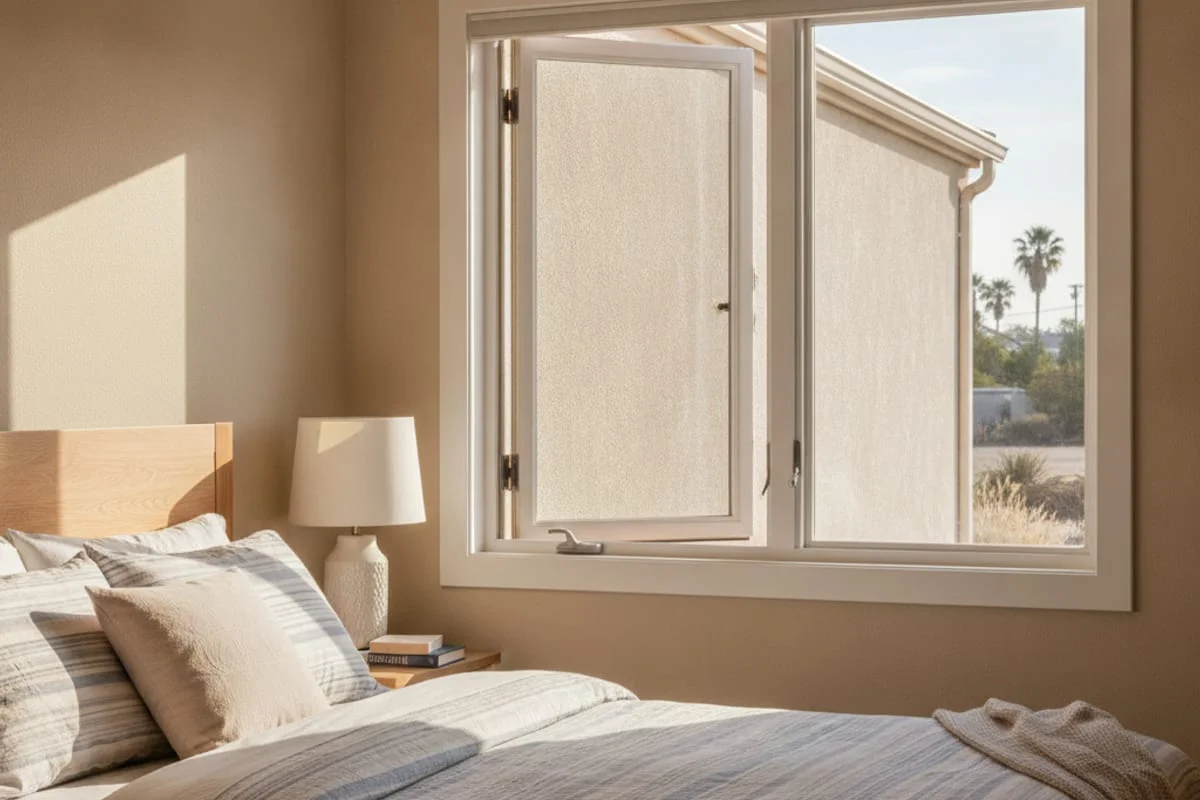
What egress windows are and why they matter
Egress means emergency exit. An egress window is a window in a sleeping room that is large enough for an occupant to climb out of, or for a firefighter to climb in through, during an emergency. California building code requires every sleeping room to have at least one egress-compliant window, and the requirements apply to new installations and to window replacements that trigger a permit.
In San Diego County, many homes built between 1940 and 1980 have bedroom windows that would not meet current egress sizes. Inside the City of San Diego, a building permit is required. Same-size, same-type replacements can use a No-Plan Building Permit under Information Bulletin 203, which is still a permit. Enlarging a sleeping-room opening for egress is a different path. Ask Development Services whether this bedroom opening has to grow, and have the contractor write that on the quote.
The California egress window requirements
California Residential Code Section R310 sets the egress requirements for sleeping rooms. The current requirements:
Minimum net clear opening area: 5.7 square feet for most sleeping-room windows. Ground-floor openings can use 5.0 square feet. This is the unobstructed opening when the window is fully open, not the overall window size.
Minimum net clear opening height: 24 inches minimum.
Minimum net clear opening width: 20 inches minimum.
Maximum sill height: The bottom of the clear opening cannot be more than 44 inches from the finished floor. This allows a person to get over the sill from inside the room.
These four requirements must all be met simultaneously. A window that has a 5.7 square foot opening but a sill height of 50 inches does not meet egress because the sill is too high. A window with a sill at 40 inches but only 4.5 square feet of clear opening does not meet the area requirement.
The requirements apply to sleeping rooms, which California defines functionally: any room used or intended to be used for sleeping. A “bonus room” used as a bedroom is a sleeping room for code purposes regardless of what the permit plans call it.
How to calculate the clear opening on your window
The net clear opening area is calculated after the window is opened to its maximum position. For a double-hung window, this means one sash raised to its maximum. For a casement, the window fully cranked open. For a slider, the panel opened to its maximum travel.
On a standard 36-inch by 48-inch double-hung window, the nominal dimensions are 3 feet by 4 feet, or 12 square feet. But the net clear opening is much smaller: the rails and stiles of the sash reduce the opening, and only one sash opens. A typical 36x48 double-hung might provide 5.5-6.0 square feet of net clear opening, which is close to the 5.7 square foot minimum and may or may not pass depending on exact configuration.
On original aluminum sliders, the situation is often worse. A common 30x24 original aluminum slider provides well under 5.7 square feet of clear opening and does not meet egress requirements. Replacing that window with a conforming egress unit requires either a larger window in the same rough opening (if the opening is large enough) or enlarging the rough opening.
When egress compliance is triggered in San Diego
A replacement window in a sleeping room triggers egress review during the permit process. If the replacement window meets the egress requirements, there is no additional work. If the replacement window would not meet the requirements (either because you chose a smaller window or because the rough opening is too small for a compliant window), the building department will require the opening to be enlarged.
This matters on projects where the existing window is clearly under-sized. A homeowner replacing a 24x18 original aluminum slider in a bedroom with a same-size vinyl slider is replacing an illegal-egress window with another non-compliant window. The permit inspector will flag it.
The practical implication: if you have small bedroom windows in a pre-1980 San Diego home, budget for the possibility that egress compliance will require enlarging the rough opening. This is full-frame territory, and the framing work adds $600-$1,200 per window on top of the window itself.
Rough opening enlargement: what it involves
Enlarging a rough opening to accommodate an egress window is framing work. The existing rough opening is enlarged by cutting back the king studs, modifying the header, and rebuilding the rough sill at the correct height. On a typical 2x4 stud wall with a non-load-bearing window location, this is a half-day of carpentry work. On a load-bearing wall, the framing work is more complex and requires the header to be properly sized for the span.
On a stucco exterior, enlarging the rough opening means cutting the stucco around the opening, doing the framing work, installing the new window, flashing it properly, and patching the stucco. A rough opening enlargement on a typical San Diego stucco home runs $800-$1,800 per window including the framing, the window itself, and the stucco patch.
Common egress situations in San Diego homes
1950s-1960s beach bungalows in Ocean Beach, Pacific Beach, and Mission Hills: Often have original steel-frame casement windows in bedrooms. These may or may not meet current egress dimensions depending on the original size. A condition inspection before deciding on a replacement product is the right first step.
1970s-1980s tract homes in Santee, El Cajon, La Mesa, and Chula Vista: Common configuration is a 36x24 or 36x30 slider in the bedroom. A 36x30 slider may just meet egress if the clear opening checks out at 5.7 square feet. A 30x24 typically does not.
Additions and conversions: Any room converted to a sleeping room use that did not originally have an egress window is particularly vulnerable. An attached garage converted to a bedroom without a permit in the 1990s, or an unpermitted bedroom added to a Mira Mesa home in 2005, may have windows that were never reviewed for egress compliance. These situations require a permit and a compliance path when the windows are eventually replaced.
Basement bedrooms: San Diego homes with basement or below-grade bedrooms are relatively uncommon, but they exist in older hillside homes in La Jolla, Mission Hills, and Hillcrest. Below-grade egress window requirements are more stringent and may require a window well.
Egress windows and security
The most common concern homeowners raise about egress windows is security: a window large enough for a person to exit through is also large enough for someone to enter through. This is true, and it is worth thinking about.
The practical answer is a window lock that is operable from inside without a key (required for egress) but that prevents opening from outside. Most modern window manufacturers include this as a standard feature on egress-compliant windows. Locking pins on sliders and double-hungs, keyed locks on casements, and security sensors wired to an alarm system are all compatible with egress compliance. The lock has to be operable without a key from inside the room.
How to handle egress compliance in a replacement project
If you are replacing windows in sleeping rooms, the right sequence is:
- Identify every sleeping room in the home, including any rooms used as bedrooms that may not be labeled that way on the permit plans.
- For each bedroom window, measure the existing clear opening area at its maximum open position. Compare to 5.7 square feet.
- For windows that are below 5.7 square feet, check the rough opening size to see whether a larger replacement unit can fit in the existing rough opening, or whether enlarging the opening is required.
- Pull a permit for the replacement project and let the building department review the egress compliance as part of the inspection.
For the San Diego homeowner version of these numbers, including when the opening has to grow, see egress window installation. For how full-frame work fits a larger opening, see full-frame replacement.
The bottom line
California Residential Code R310 requires 5.7 square feet of net clear opening in most sleeping rooms (5.0 square feet is allowed at grade), with a 24-inch minimum height, 20-inch minimum width, and 44-inch maximum sill height. Many pre-1980 San Diego homes do not currently meet these requirements, and a bedroom window replacement is when the department checks. Enlarging a rough opening is extra framing and stucco work on top of the window itself. Ask the installer to write that path on the quote before you sign.
Call (858) 400-6418 to connect with a local window crew across San Diego County that handles egress window projects, including rough opening enlargement. Verify any contractor at cslb.ca.gov before work starts.