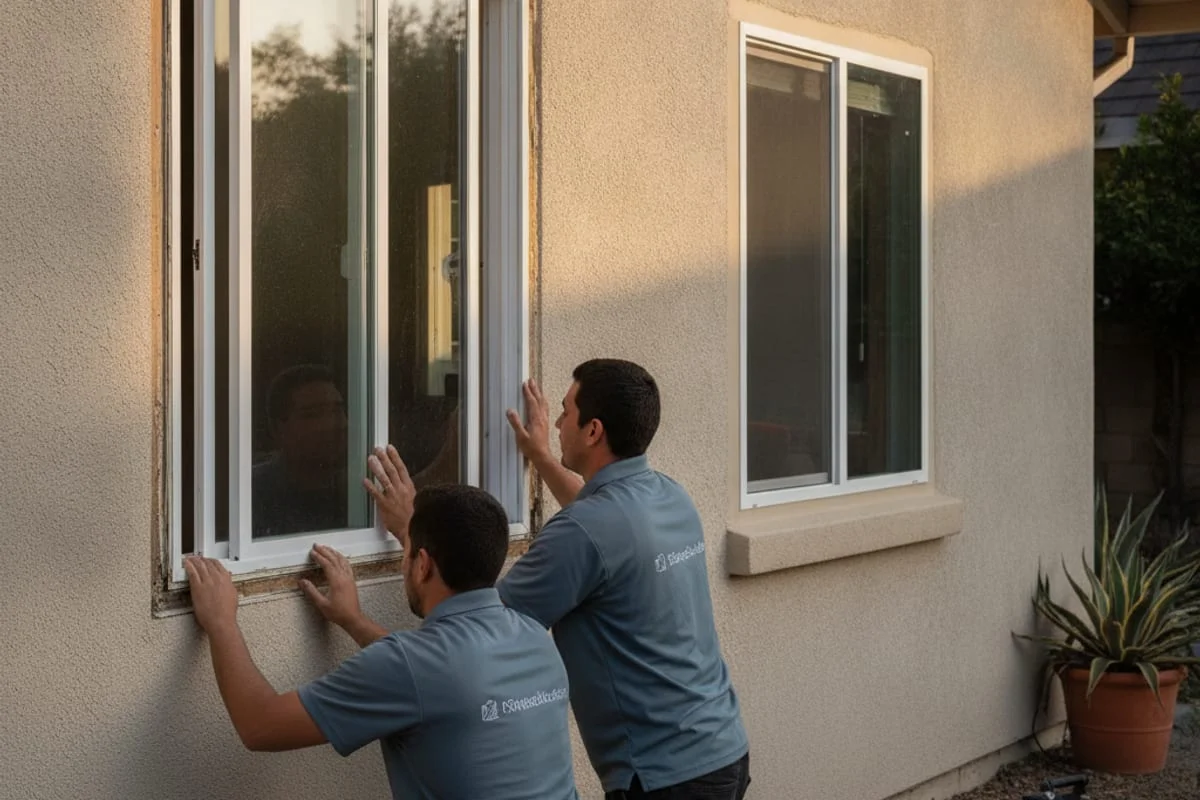
Two very different jobs with the same result
When you call for a window replacement quote, most companies will describe their process as either “retrofit” or “full-frame” replacement. These are not just contractor jargon for the same job. They describe two fundamentally different installation methods with different costs, different permitting requirements, and different outcomes for your home’s water management and long-term performance.
Understanding the difference lets you ask better questions when you get quotes, and helps you catch cases where the wrong method is being proposed for your situation.
What retrofit installation means
A retrofit replacement, also called a pocket replacement or insert replacement, installs a new window unit inside the existing frame. The existing frame stays in place, the exterior stucco and interior trim are not disturbed, and the new window slides in and is secured to the existing frame, then sealed.
The key constraint: the new window unit is always slightly smaller than the original rough opening because the existing frame stays in place and the new unit fits inside it. A standard retrofit loses 1-2 inches of visible glass area on each side. For most windows this is not meaningful. For a narrow bathroom window or an egress window where every square inch of clear opening matters, it can matter.
The practical advantages of retrofit are real: less disruption, faster install when the frame is sound, and no stucco patch if the exterior stays. Labor is usually lower than full-frame. This site publishes vinyl retrofit at about $650-$1,200 installed and full-frame at $900-$1,600. Use those bands, then the written quote.
Retrofit is appropriate when:
- The existing frame is structurally sound with no rot, corrosion, or physical damage
- The rough opening sizing is correct for the window type and size you want
- The existing flashing and water management layer behind the stucco is intact
- You are not changing the window type or size
What full-frame installation means
Full-frame replacement removes everything, down to the rough opening in the framing. The existing frame, sill, jambs, and exterior trim all come out. The new window unit is installed directly into the rough opening with new flashing, a new nail fin, and new integration with the water-resistive barrier behind the stucco. Then the stucco is patched, and the interior is re-trimmed.
Full-frame costs more because the crew opens the wall, repairs the opening, and patches stucco. That premium is why the published full-frame band is $900-$1,600 versus retrofit $650-$1,200. On a whole-house job the difference is the count times that gap, not a separate lump sum invented here.
Full-frame is required when:
- The existing frame has rot, active corrosion, or structural damage
- The flashing or water-resistive barrier behind the frame is compromised (common on 1970s-1980s homes that used tar paper that has since failed)
- You are changing the window size or type
- You are adding a window in a new opening
- Egress compliance requires resizing the rough opening
- The existing frame profile is so deteriorated that a retrofit would create a poor seal
The water management question
The most important reason to choose full-frame over retrofit in San Diego is not cosmetic or structural, it is about water management. The exterior of a window is where the building envelope is most vulnerable to water intrusion, and the flashing that integrates the window to the water-resistive barrier is what keeps that envelope intact.
On a retrofit installation, the existing flashing and water-resistive barrier are not touched. If they were installed correctly in the first place and are still intact, that is fine. If they were installed incorrectly, or if the tar paper or housewrap behind the stucco has deteriorated, a retrofit installation does not fix those problems. You get a new window installed on top of a compromised water management system.
On homes built before 1990, particularly homes with original aluminum windows and original tar paper behind the stucco, the flashing condition is worth evaluating before a retrofit is the only option on the table. An experienced window installer can probe the sill area to check for deterioration before committing to a method.
What to expect on a San Diego stucco home
Most San Diego homes have stucco exteriors, and the stucco creates specific considerations for both installation methods.
For retrofit, the stucco is left in place. The installer removes the interior and exterior trim, seats the new window unit against the existing frame, seals with backer rod and caulk at the exterior, and replaces the trim. The stucco face is not cut or patched.
For full-frame, the stucco is cut back around the opening so the new flashing can lap the weather barrier, then patched after the window is in. Color match on old stucco is imperfect. Many homeowners time an exterior paint with the window job for that reason. Ask the installer to price the patch as a line, not as a surprise.
Permits for both methods
Inside the City of San Diego, a building permit is required for both methods. Information Bulletin 203 is the No-Plan path for same-size, same-type work. It is still a permit. Other cities and the county set their own rules. A contractor who says you can skip the permit because the hole is the same is not following City of San Diego rules. Verify who pulls the permit on the quote.
For more on what Title 24 requires for your specific installation, see the energy-efficient window and Title 24 guide.
How the decision plays out on a real San Diego project
A typical scenario: a 1985 Rancho Bernardo tract home with 12 original single-pane aluminum sliders, no visible frame rot, and original tar paper behind the stucco. The aluminum frames are physically intact but thermally terrible.
A retrofit is technically possible here, but the right question is the condition of the weather barrier behind the existing frames. Probe the sill. If it is intact, retrofit can be the right method. If it is brittle or missing, full-frame plus new flashing is the durable path. Price both from the published bands, not a $3,000-$5,000 guess.
Another common scenario: a 1960s Point Loma bungalow with original steel-frame casement windows. These cannot be retrofit in the conventional sense because the profiles do not match modern frame dimensions. Full-frame is the right call, and the project budget should reflect it.
For the specific installation method that applies to your home, connecting with a local crew who will assess the existing condition before recommending a method is the right first step. See the window replacement installation services page for more on how we match homeowners with the right installer for the job.
The bottom line
Retrofit is the right answer when the existing frame is sound and the water management layer behind it is intact. Full-frame is necessary when there is rot, failed flashing, or a change in opening size. Choosing the cheaper method on a rotten sill is the expensive mistake.
Call (858) 400-6418 to connect with a local window crew across San Diego County who will assess your existing windows and recommend the right installation method for your home.