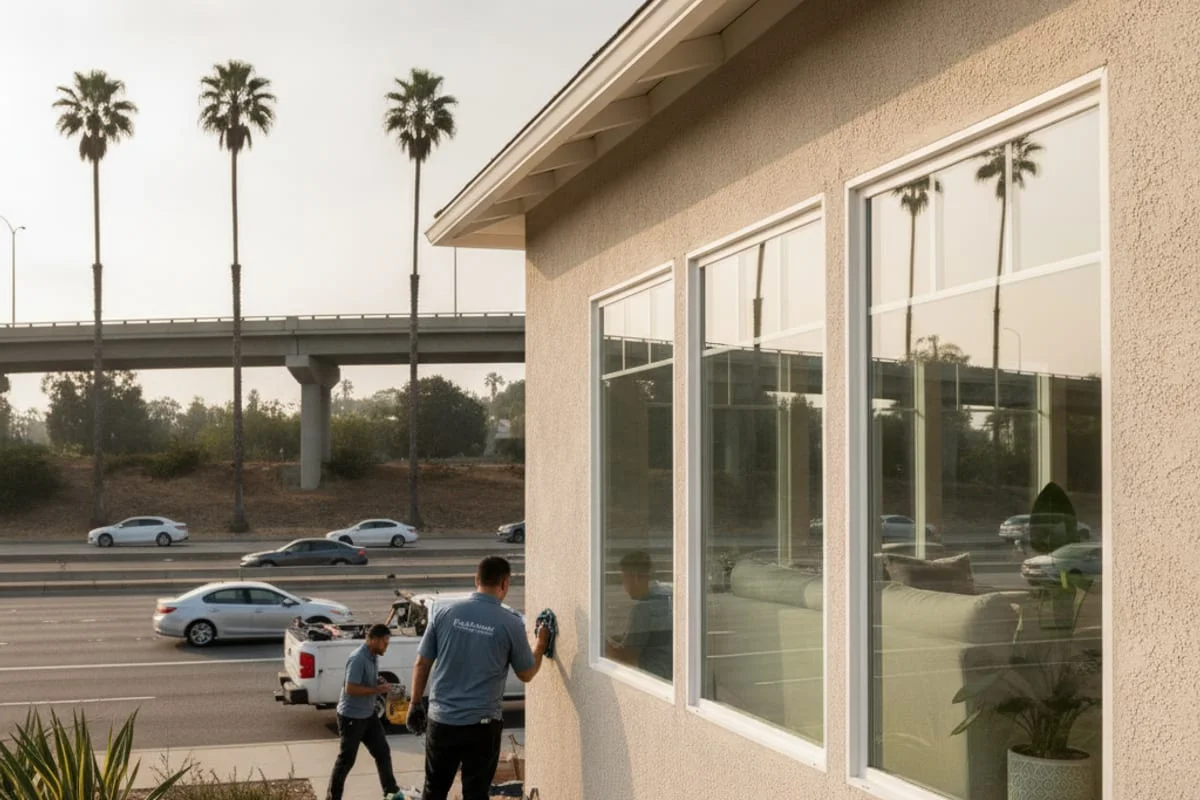
Why windows are the primary noise path in San Diego homes
San Diego is a freeway city. The 5, 8, 15, 805, 163, and 94 corridors run through dense residential neighborhoods, and the homes that sit within a quarter mile of those corridors deal with traffic noise as a daily reality. Add local arterial roads, the flight path from Lindbergh Field affecting neighborhoods from North Park through Hillcrest and Mission Hills, and marine industrial activity in Logan Heights and National City, and noise is one of the most common quality-of-life complaints in San Diego residential real estate.
Windows are the primary noise path because they are the thinnest and least massive element of the building envelope. A typical exterior wall with stucco, sheathing, insulation, and drywall has a Sound Transmission Class (STC) rating of 40-45. A single-pane aluminum window has an STC rating of 18-24. A standard double-pane window runs 26-32. The windows are the weak link.
STC ratings and what they mean in practice
STC (Sound Transmission Class) is the standard measurement of how well a partition reduces airborne sound. Higher is better. The relationship to perceived noise is roughly:
- STC 25-30: Normal speech can be understood through the partition
- STC 35-40: Loud speech sounds muffled; normal speech not understood
- STC 40-45: Loud speech barely audible
- STC 50+: Most sounds are greatly attenuated; a loud voice is barely audible
Standard double-pane vinyl windows run STC 26-32. Laminated double-pane glass (with a PVB interlayer) runs STC 32-38. Acoustic laminated glass with a thicker interlayer in a wider airspace double-pane unit can reach STC 38-48.
For a home next to the 805 in National City or the 8 in Mission Valley, the difference between STC 28 (standard double-pane) and STC 40 (acoustic laminated) is meaningful: the latter makes loud freeway noise sound muffled rather than present. It is not silence, but it is a significant reduction.
What makes a window more effective at blocking noise
Three design factors drive acoustic performance in windows:
Glass mass: Heavier glass blocks more sound. A window with 1/4-inch (6mm) glass is more effective than the same window with 3/16-inch (5mm) glass. Thicker glass is one reason laminated glass windows outperform standard double-pane on acoustic performance.
Laminated glass: A laminated glass lite has a thin PVB (polyvinyl butyral) or SGP interlayer bonded between two glass panes. The interlayer acts as a damping layer that absorbs vibrational energy from sound waves, rather than transmitting it. A 3/16+PVB+3/16 laminated glass unit performs acoustically much better than the equivalent total thickness in monolithic glass. This is why car windshields (which are laminated glass) are quieter than side windows (which are not).
Airspace: A wider airspace between panes in a double-pane unit allows more sound wave dissipation across the cavity. Standard double-pane units have 1/2-inch to 3/4-inch airspace. Acoustic units can use 3-inch or 4-inch airspace for further improvement, though these are specialty products not commonly stocked.
Frame and seal quality: The best glass package in the world does not help if there is a gap at the frame-to-rough-opening seal or a failed weatherstrip that allows sound to flank around the glass. An acoustic window installation has to address the seal, not just the glass.
Options for noise reduction in San Diego window replacement
Upgrade to standard double-pane: A home with original single-pane aluminum windows getting an upgrade to standard double-pane vinyl will see meaningful noise reduction at minimal additional cost over the baseline window replacement. The STC improvement from STC 20 (single-pane aluminum) to STC 28-32 (standard double-pane) is real. This is the baseline for any noise-affected home that needs window replacement anyway.
Specify laminated glass in noise-facing windows: Many manufacturers offer laminated glass as an upgrade. Ask for the STC or OITC on the NFRC or manufacturer sheet for the exact unit. Do not treat a dollar adder as a published Window Pro price.
Acoustic specialty windows: Homes next to a freeway interchange or a flight path sometimes need a specialty acoustic unit with a wider airspace and laminated glass on both lites. Those products are sold by acoustic specialists, not as a standard vinyl retrofit. Get a written quote for the exact opening.
Retrofit acoustic inserts: Interior acoustic inserts (a second glazed panel inside the existing frame) are a different product from replacing the window. Companies like Indow make custom inserts. Whether they need a permit depends on whether the opening, egress, or ventilation changes. Ask the building department that serves the address. They also shrink the clear opening, which matters in a bedroom.
Specific San Diego corridors where noise reduction is most common
5 and 163 corridor (Mission Hills, Hillcrest, North Park, South Park): Flight path noise plus I-5/I-163 interchange noise. Homes fronting or backing these freeways are common candidates for laminated glass on the freeway-facing side.
8 corridor (Mission Valley, El Cajon, Santee): I-8 noise affects homes in Mission Valley between I-5 and I-15, and in El Cajon along the valley floor. The valley topography can concentrate noise in some locations.
805 corridor (National City, Chula Vista, Spring Valley): The I-805 runs through dense residential areas in National City and western Chula Vista where homes are within 500 feet of the freeway.
15 corridor (Mira Mesa, Rancho Bernardo, Escondido): Significant residential noise impact in Mira Mesa and on the south end of Rancho Bernardo near the 15/56 interchange.
Lindbergh Field flight path: The primary approach path affects a band from Hillcrest through Mission Hills, with secondary path noise affecting North Park and University Heights. Aircraft noise peaks during arrival periods and is a different frequency profile than freeway noise.
What to expect from a noise reduction window project
Setting expectations correctly matters. A window replacement with laminated glass on noise-facing windows will make a meaningful difference that you will notice daily. It will not make a home next to a freeway interchange quiet. The goal is reducing noise from intrusive to background-level, not eliminating it.
Laminated glass on a noise-facing wall usually turns individual cars into a lower hum. How much it helps depends on the wall, the glass, and the street. Ask for a written STC or OITC on the unit you are buying instead of a neighbor story.
For the best outcome, pair the window replacement with an air-sealing check to close any flanking paths (gaps at utility penetrations, attic bypasses, door gaps) that allow sound to enter through paths other than the windows.
For the full picture on window selection and installation for noise-affected homes, see the window replacement service overview. For guidance on frame material and glass options that combine acoustic performance with energy efficiency, see the energy-efficient windows guide.
The bottom line
Windows are the primary noise path in most San Diego homes, and the gap between single-pane aluminum and laminated double-pane glass is the most impactful improvement available to noise-affected homeowners. Standard double-pane with laminated glass (STC 34-40) is the right specification for most homes near San Diego’s freeway and arterial corridors. Specialty acoustic windows are available for the most extreme situations.
Call (858) 400-6418 to connect with a local window crew across San Diego County that can specify the right glass package for your noise situation. Verify any contractor at cslb.ca.gov before signing.