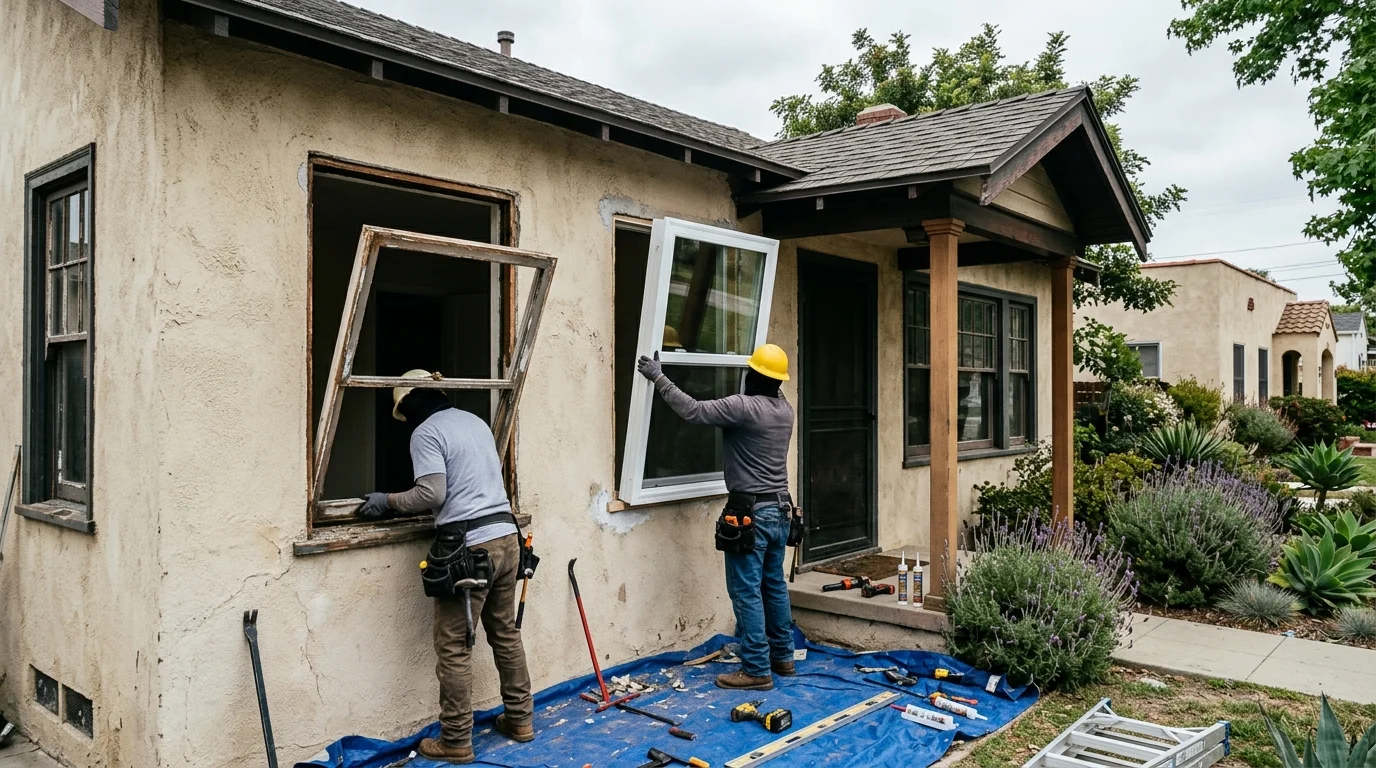
The painted double-hung on a North Park craftsman is not a Clairemont slider with extra charm. The sash, the jamb, and the sill are one wood box nailed into the wall. When that box is soft, a new insert sits in rot. Full-frame replacement is the usual path here, because the wood frame is the window.
Painted wood sash in pre-war and craftsman San Diego
Walk 28th Street in North Park, or the blocks above Balboa Park in South Park and Golden Hill, and you are looking at original wood openings. Mission Hills keeps the same stock on a larger lot: craftsman, prairie, and a few Spanish houses with painted sash on the side walls. Ocean Beach and Point Loma cottages sit in marine layer instead of canyon heat. The paint fails in a different order. The window is still a wood box.
These are not the mill-finish aluminum sliders that went into inland tract ranchers. That job lives on the aluminum window replacement post. Wood sash is a central-city, pre-war problem. The meeting rail, the horns, the pulley pockets, and the exterior casing are part of the house’s face. Treat this like a vinyl retrofit in Mira Mesa and you leave the old jamb in the wall.
The glass is often still single pane, set in glazing putty, under many coats of paint. The sash may be double-hung, casement, or a picture unit with an operable pair beside it. None of that is a jalousie. Louvered glass is a different assembly. A sash that will not stay up is sometimes just a failed cord or balance. That is a hardware call, not automatically a tear-out.
What makes this belt local is the mix of stucco, wood siding, and narrow lots. Golden Hill and South Park take afternoon sun on west walls. Mission Hills sits higher and dries faster. The Ocean Beach and Sunset Cliffs cottages stay damp through June gloom. Same county, different wood. The pro you get matched with has to read the elevation, not a catalog page.
Census figures already used on this site put 49.6% of San Diego housing before 1978. In these neighborhoods the share is older still. Pre-war bungalows are well past 45 years. That age matters once you are inside City of San Diego rules. First you decide whether the box is still a window.
Rot at the sill versus a sash that still squares
Start at the sill. Press it with a screwdriver, not a knuckle. Sound wood pushes back. Failed wood dents, darkens, or lets the tool in at the bottom corners where paint has cupped. The bottom rail of the sash and the interior stool often fail in the same place, because water sits there. Coastal cottages see that from fog and salt. Inland bungalows see it from irrigation spray and south-facing bake, then rain into the splits.
A sash that still squares is a different finding. The corners hold 90 degrees. The meeting rail closes without a wedge of daylight. The glass is still tight in its putty. You can lift it without the stile twisting. That sash may need cords, weatherstrip, or a new pane. The jamb and sill may still be doing their job. Replacing the whole unit because the paint looks tired is a jump.
When the sill is gone, the opening is the problem. The old frame is the window. An insert clips to that frame. If the frame is rotten, the new unit hangs on a wet stick. Full-frame work pulls the sash, the jamb, the sill, and the exterior casing back to the rough opening. Then the new unit is the new box. That is why this stock usually skips the retrofit path used on later aluminum.
Look at the exterior too. Peeling at the head is often sun. Softness at the horn and the sill horn is water. Daylight at the side jambs means the unit has shrunk or the house has moved. Stucco cracked in a U around the opening is a flashing and water story, not a glass story. None of that comes with a year count. Wood fails by exposure and paint neglect, not by a calendar we can publish.
If only one opening is soft, treat that opening. A North Park bungalow can have a failed bath window on the south wall and sound living-room sash on the porch. The matched pro should say so. A whole-house speech on ten good sashes is sales, not diagnosis.
Lead paint and historic review can stack on the same opening
Two rules can hit the same North Park opening. They come from different agencies.
First, lead. EPA’s Lead Renovation, Repair, and Painting Rule treats window replacement as a renovation. The minor-repair exemption (6 square feet interior, 20 square feet exterior) does not include window replacement, even if the window itself is smaller than 6 square feet. That is 40 CFR 745.83, as EPA reads it. Replacing a pane of glass or fixing a balancer is not “window replacement” for RRP. It can still be covered if painted surface is disturbed beyond those minor-repair limits. On painted wood in a pre-1978 bungalow, assume RRP applies until a certified inspector, risk assessor, or certified renovator using an EPA-recognized test kit or paint-chip sample shows the affected parts are below 1.0 mg/cm2 or 0.5% lead by weight. Keep those records.
Window Pro SD does not hold that certification and does not do the work. The independent pro you are matched with should. Confirm the firm on epa.gov. We are not publishing EPA penalty amounts. Ask the pro to show RRP paperwork before anyone scores paint on a Golden Hill sill. The longer lead paint window replacement post walks the same rule in more detail.
Second, the City of San Diego. This paragraph is for the City, not Chula Vista, not Encinitas, not the unincorporated county. Each of those is its own building department. Inside the City, Information Bulletin 203 says a building permit is required for window replacement. Same-size, same-type replacement can use a No-Plan Building Permit. That is a permit without plan review, not a skip. IB 203’s condition is that the doors or windows must be the same size and type as the existing ones, with no change to the existing opening size. Only structures that were legally permitted, built, and passed final inspection may use a No-Plan permit.
Historical review is required for a parcel with a designated historical resource or inside an adopted historic district. A building 45 years or older requires plans submitted for historic review unless the scope is exempt. Pre-war bungalows in North Park, South Park, Golden Hill, and Mission Hills clear that age without a close call. The historic review post is the place for the sequence. Confirm the current bulletin with City of San Diego Development Services.
Those two layers stack. RRP is federal work practice on the paint. Historic review is a City paper path on the elevation. A pro who only talks about vinyl color is not ready for this belt.
Repair the wood or replace the unit
Repair is honest when the box is sound. New cords or balances, fresh putty, a sistered sill nosing, hardware that latches. If the sash still squares and the jamb is dry, you are restoring a window, not buying a new one. Window Pro SD does not mill sash. The matched local contractor might repair, or they might tell you the opening is past that.
Replace the unit when the frame is the failed part. That is full-frame work, not an insert dropped into a rotten jamb. You can get wood replacement windows. You can get wood with cladding. You can get other frame materials painted to read as sash from the street. Whether City historic staff will accept a given look is their call on that elevation. Do not let a salesperson treat a Mission Hills craftsman like a tract slider.
California work of $1,000 or more in aggregate contract price requires a licensed contractor under Business and Professions Code section 7048. Splitting a job to dodge that threshold does not create an exemption. Glazing work sits in the C-17 classification. California Code of Regulations title 16, section 832.17 says a glazing contractor selects, cuts, assembles, and/or installs all makes and kinds of glass and glass substitute materials for glazing, executes the fabrication and glazing of frames, panels, sashes and doors, and/or installs these items in any structure. Check the number on the CSLB license lookup before anyone opens a wall. We do not publish that C-17 is the only class that may touch a window. A B general contractor’s scope is a separate question.
The federal 25C energy credit is terminated for property placed in service after December 31, 2025. Windows installed in 2026 do not qualify. Do not budget for a tax credit that is closed. Comfort, operation, and a dry opening are the reasons to replace. We are not publishing bill-savings percentages or resale-return figures. Those depend on the house, and we do not have a San Diego study to cite.
What a full-frame swap has to match on the elevation
On the street in South Park, the window is the elevation. Rail heights, horn profiles, the number of lites, and the trim around the stucco all read from the sidewalk. A full-frame swap has to land in the same hole, then look like it belongs in the wall that was already there.
For a City of San Diego No-Plan permit, same size and same type is the IB 203 test. A double-hung that becomes a slider is a type change. A picture window that grows into the header is a size change. Either one leaves the No-Plan path. Bedroom openings still have to meet 2022 California Residential Code section R310 if they are the emergency escape opening: 5.7 square feet of net clear opening, or 5.0 square feet at grade-floor or below-grade, at least 24 inches high and 20 inches wide, with the bottom of the clear opening no more than 44 inches above the floor. Measure the opening, not the rough-opening sill.
Energy rules are on a different sheet. The 2025 Building Energy Efficiency Standards took effect January 1, 2026. San Diego County sits in Climate Zones 7 and 10. The prescriptive maximum fenestration U-factor in those zones is 0.30. The mandatory maximum U-factor is 0.40 in every climate zone. California Energy Code section 150.2(b), as read in the 2022 edition, lets you replace up to 75 square feet of vertical fenestration at a U-factor no greater than 0.40, with SHGC no greater than 0.35 in the listed zones, which include 7 and 10. Larger jobs meet the prescriptive numbers. The 2025 book is reported to keep that exception. We did not reach its verbatim text. Confirm the current edition with the building department, and use the California Energy Commission as the parent source. For a named product, use the NFRC label and the current ENERGY STAR windows criteria for the Southern zone. We are not publishing those numeric thresholds here.
Trim is part of the match. Wood casing on a craftsman is not a stucco-return nail fin from a 1970s ranch. Pulling the frame means the exterior gets rebuilt. Ask the pro, on paper, what happens to the horns, the stool, and the apron. Ask how the new unit sheds water at a Golden Hill west wall, where afternoon sun cooks the sill, and at an Ocean Beach cottage, where the marine layer never really leaves.
When to call us
Call when the sill is soft, the sash no longer squares, or a City of San Diego opening is old enough that historic review and lead-safe work may both apply. Window Pro SD matches you with a licensed, independent local window contractor. We do not mill sash, pull permits, or hold a C-17. Call us at (858) 400-6418 and we’ll connect you with a licensed local window contractor.