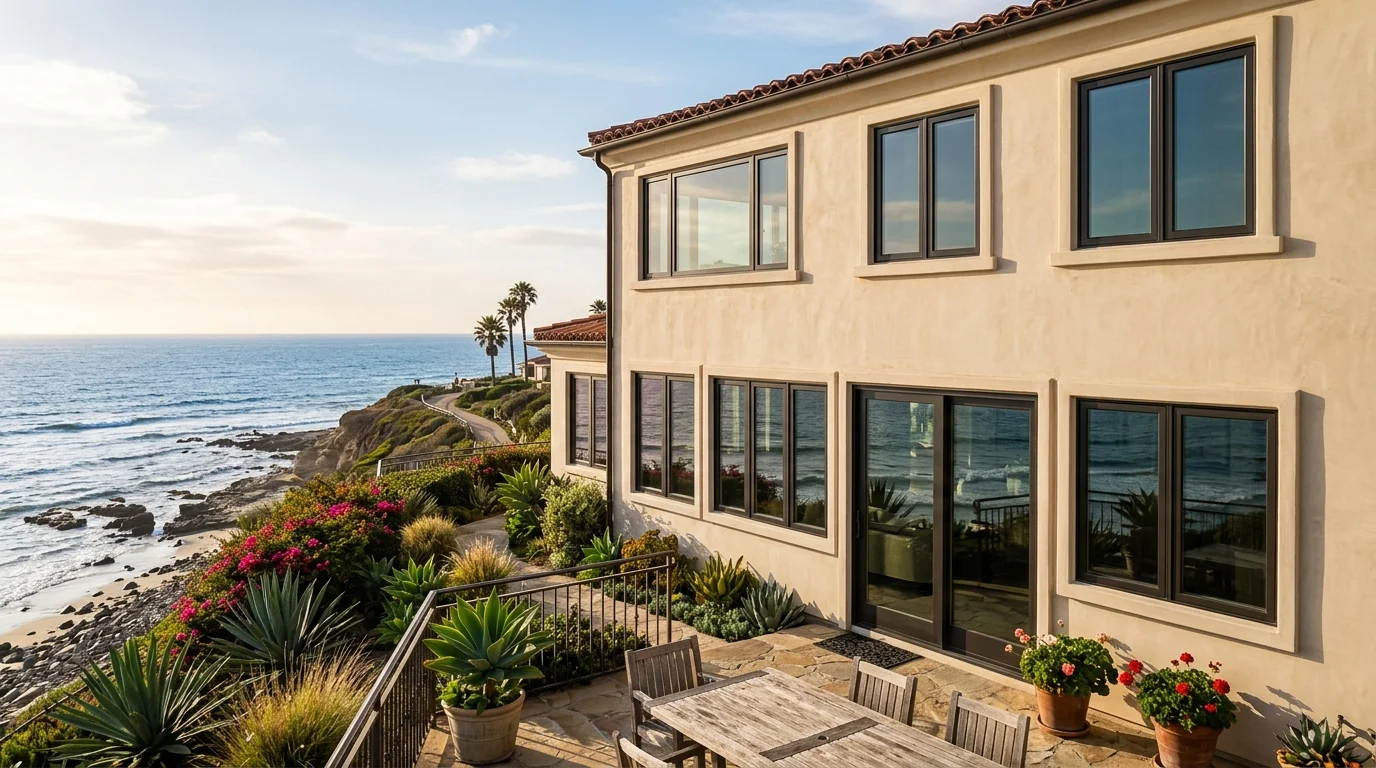
A Carlsbad west wall takes salt in the morning marine layer and sun after noon. That is the opening that sends people looking for fiberglass replacement windows in San Diego: a dark vinyl sash that oil-cans, or aluminum that pits in the spray. The frame is the decision. The glass package comes after.
What a fiberglass replacement window actually is
A replacement window is a factory unit: frame, sash, insulated glass, hardware, and weatherstrip. Fiberglass, on a real quote, means a pultruded frame. Glass fibers are pulled through resin and cured into a rigid profile. That profile is what sits in the stucco reveal.
It is not vinyl with a little glass filler. It is not a wood window with a fiberglass skin unless the line item says that in those words. “Composite” and “fiberglass-reinforced” on a brochure often mean something else. If you want fiberglass windows, the paper has to say pultruded fiberglass for the frame.
The physical argument is expansion. The glass in an insulated unit expands and contracts at a known rate. Pultruded fiberglass moves in a similar range. Vinyl moves more. Aluminum moves more the other way and conducts heat through the frame. That is why dark factory finishes and large west-facing sashes show up in fiberglass specs. It is not a brand pitch.
San Diego County sits in California Climate Zones 7 and 10. The 2025 Building Energy Efficiency Standards took effect January 1, 2026. The prescriptive maximum fenestration U-factor is 0.30 in Climate Zones 6-10 and 15, so 0.30 is the prescriptive number for this county. The mandatory ceiling is U-0.40 in every climate zone. California Energy Code section 150.2(b) lets you replace up to 75 square feet of vertical fenestration at U-0.40, with SHGC no greater than 0.35 in the zones that include San Diego, instead of meeting the full prescriptive 0.30. That exception text was read from the 2022 edition. Confirm the current edition with your building department. The California Energy Commission publishes the standards. A fiberglass unit still needs an NFRC label for those numbers. Frame material alone does not prove Title 24.
Energy-efficient windows are a whole assembly: glass, spacer, gas fill, and frame. ENERGY STAR is a separate check. Southern-zone numeric criteria are not restated here. Verify a specific product on the ENERGY STAR windows page.
Window and glazing work falls inside the C-17 Glazing Contractor scope in Cal. Code Regs. tit. 16, sec. 832.17. That section covers selecting, cutting, assembling, and installing glass and glass-substitute materials, and fabricating and installing frames, sashes, and doors. Whether a B general contractor may do the same work is a separate question. Check the person on your job through the CSLB license lookup. California Business and Professions Code section 7048 requires a contractor license when the aggregate contract price for labor, materials, and all other items is $1,000 or more. That threshold was amended effective January 1, 2026.
Coastal salt and East County heat: where fiberglass earns its place
Carlsbad, Encinitas, and La Jolla west walls are the salt case. El Cajon and Poway west walls are the heat case. Fiberglass earns a place in both for different reasons.
On the coast the morning marine layer leaves a film on the glass. Wind off the water drives salt into weatherstrip, weep holes, and hardware. Aluminum frames oxidize and pit in that air. Vinyl does not rust. A dark vinyl sash on a west wall can still soften and bow when a cool morning turns into a hot afternoon. Fiberglass does not rust. It holds a factory dark finish without the same expansion fight against the glass. That is the coastal reason people specify it on bluff lots in Encinitas and street-to-ocean lots in Carlsbad and La Jolla. Hardware still needs rinse-down. The frame is only half the salt story. For the rest of the coastal detailing, read windows for coastal salt air in San Diego.
East County is a different climate on the same county map. El Cajon and Poway sit inland of the marine layer. West walls bake from mid-afternoon on. A dark frame on that wall is a heat load on the sash, the lock, and the seal. Fiberglass is the material people reach for when they want the dark look and a frame that stays in plane with the glass. Vinyl remains the volume product on lighter colors and milder walls. That split is local, not a national talking point.
Very High Fire Hazard Severity Zone maps also run through inland pockets of the county. Cal Fire’s 2025 maps raised San Diego County “Very High” acreage. CBC Chapter 7A section 708A.2 requires exterior windows in those applications to be multi-pane with at least one tempered pane meeting the safety-glazing section, or an assembly tested to SFM Standard 12-7A-2. Both paths count. Frame material is not the 7A test. Multi-pane glass is. If your parcel sits in a mapped zone, ask the pro to name which path the unit takes.
Dark frames, expansion, and the vinyl comparison
Dark frames are the fashion on new stucco and on 1970s ranch remodels from Carlsbad to Poway. They are also the stress test. A dark exterior absorbs more solar heat than a white or beige one. The sash gets hotter than the glass. Vinyl expands more than the insulated unit it holds. On a west wall in El Cajon or Poway that shows up as a bow, a sticky lock, or a meeting rail that no longer lines up. Pultruded fiberglass expands closer to the glass, so the dark finish is less of a fight.
That is the comparison this page owns. The three-way materials write-up lives at vinyl vs fiberglass vs aluminum windows. The vinyl product write-up lives at vinyl replacement windows in San Diego. The heat-and-color write-up lives at black window frames and San Diego heat. This page is the fiberglass replacement product.
Vinyl is still the right call on many openings. Light colors, shaded east walls, and budget-first whole-house jobs often stay vinyl. Fiberglass is the spec when the wall is west, the finish is dark, the opening is large, or the house sits in salt air and the homeowner does not want aluminum. Do not let a salesperson collapse those cases into “upgrade.” Ask which walls get which material.
Watch the naming. Some national lines sell vinyl, composite, and fiberglass under related names. A showroom photo of a dark frame is not a material call. The quote has to name pultruded fiberglass, the series, and the exterior finish system. Factory-applied dark finishes belong in writing. Field paint on a vinyl or mixed frame is a different product. Window Pro SD is not a dealer for any fiberglass brand. The licensed pro you contract with sources the unit.
Retrofit fiberglass versus full-frame in stucco
Most San Diego houses in this conversation are stucco. The nailing fin is buried. The old aluminum or wood frame is the pocket the new unit has to live in, or the thing that comes out.
A retrofit, also called an insert, sets a new fiberglass unit inside the existing frame. The stucco stay. Interior drywall stay. The old frame has to be square, solid, and dry. If the aluminum is pitted through, the wood is soft, or the opening is out of square, an insert hides the problem. It does not fix it.
A full-frame job tears the old unit out to the rough opening. The pro rebuilds the wrap, flashing, and exterior return, then sets the new fiberglass frame to the studs. That is the path when the old frame is failing, when you are changing size, or when you need a clean stucco patch and a nailing fin. It is more opening disruption. It is also the only honest path on a rotten or racked frame. The method comparison is at retrofit vs full-frame window installation.
In the City of San Diego, a building permit is required for window replacement. City of San Diego Development Services Information Bulletin 203 is the rule. Same-size, same-type replacement qualifies for a No-Plan Building Permit, a permit issued without plan review, not an exemption. The doors or windows must be the same size and type, with no change to the existing opening size. Only structures that were legally permitted, built, and passed final inspection may use a No-Plan permit. Historical review is required for a designated historical resource or an adopted historic district. A building 45 years or older requires plans submitted for historic review unless the scope is exempt. Confirm current practice with City of San Diego Development Services. Carlsbad, Encinitas, and the other incorporated cities, plus the unincorporated county, are separate jurisdictions. Their permit rules were not confirmed for this page. Ask that city’s building department the same two questions: is a permit required for this replacement, and does same-size, same-type work still need plans.
If you enlarge a bedroom opening, 2022 California Residential Code section R310 applies. Minimum net clear opening is 5.7 square feet, or 5.0 square feet for grade-floor or below-grade openings (R310.2.1). Minimum net clear height is 24 inches and minimum net clear width is 20 inches (R310.2.2). The bottom of the clear opening cannot sit more than 44 inches above the floor (R310.2.3). Retrofit fiberglass in the old hole does not change those numbers. A bigger hole does.
Homes built before 1978 add EPA’s Lead Renovation, Repair, and Painting Rule. Window replacement is a renovation. The minor-repair exemption (6 square feet interior / 20 square feet exterior) does not include window replacement, even if the window itself is smaller than 6 square feet (40 CFR 745.83). Replacing a pane of glass or a balancer is not “window replacement” for RRP, but it is still covered unless it meets minor repair and maintenance. Keep the certified-renovator records.
What a quote has to list so you are not buying vinyl
A fiberglass quote that does not name the material is a vinyl quote with better photography. Make the paper do this work.
The frame line has to say pultruded fiberglass, not composite, not “fiberglass-reinforced,” not a brand nickname. Series and model go on the same line. Interior and exterior finish, and whether the dark color is a factory system, go next. Glass package: pane count, low-E, spacer, and gas fill, plus the NFRC U-factor on the label. San Diego County’s prescriptive U-factor is 0.30. The mandatory ceiling is 0.40. Jobs at or under 75 square feet of replacement vertical fenestration may use the 150.2(b) path at U-0.40. Ask which path the takeoff uses, and confirm the current Energy Code edition with the building department.
Install method: retrofit insert or full-frame, opening by opening. A mixed house is normal. A Carlsbad west wall with failed aluminum often wants full-frame. A protected north opening with a sound old frame can take an insert. Stucco patch, flashing, and interior casing should be named, not waved at.
License: CSLB number, classification, and a link to the lookup. C-17 covers glazing work under 16 CCR 832.17. Do not treat a business card as the license. Permit path: City of San Diego IB 203 if the house is in the City, or the named department if it is not. Historic review if the building is 45 years or older in the City of San Diego. RRP if the house is pre-1978.
Federal 25C is closed for this work. Section 25C is terminated for property placed in service after December 31, 2025. Windows installed in 2026 do not qualify. Do not let a leftover tax-credit slide stay on the proposal.
There is no published average cost for fiberglass on this page. Dollar figures that are not on the site’s itemized ranges do not belong here. Compare quotes by material, NFRC values, and install method, not by a round number on a postcard.
If a dual-pane unit has failed glass and a sound fiberglass or other frame, that can be a glass job, not a full replacement. That is a different scope. Replacement is the call when the frame is the failure, the finish is the point, or the opening needs a new unit to meet the energy path you actually have.
When to call us
Call when a Carlsbad, Encinitas, or La Jolla west wall is eating aluminum, or when an El Cajon or Poway west wall needs a dark frame that will stay in plane. A licensed window replacement pro measures the openings, names pultruded fiberglass in writing, and pulls the permit the city actually requires. Call us at (858) 400-6418 and we’ll connect you with a licensed local window contractor.