Repair or replace: the honest question
Not every window problem requires replacing the window. A failed seal between the panes is sometimes a glass-unit swap, not a new window. A stuck or broken hardware mechanism is usually a parts replacement. But some problems cannot be repaired in any meaningful way, and spending $200 on a repair that buys you two years before the window fails again is not a good use of money.
Here is how to think through the decision based on the actual problem.
The four common window problems in San Diego
Fogged glass or moisture between the panes
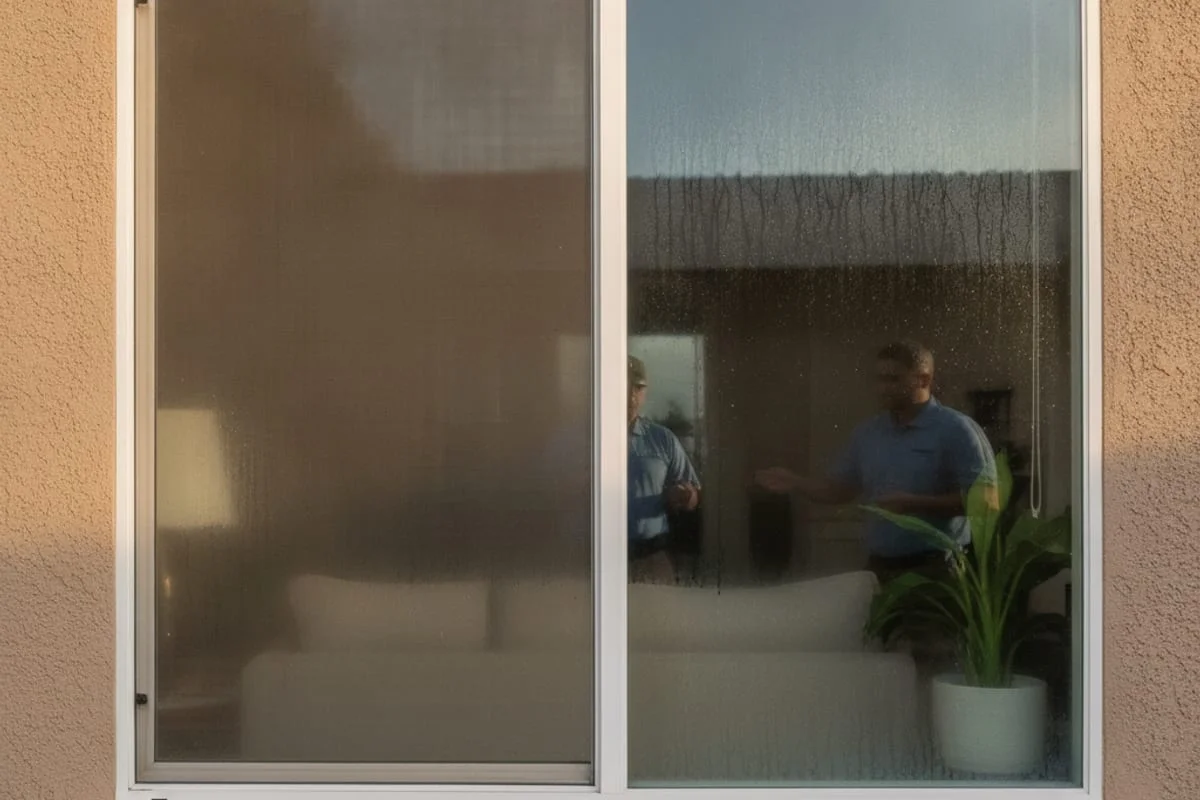
This is the most common complaint on San Diego double-pane windows. The seal between the two panes of glass has failed, moisture has gotten in, and you see a permanent fog, haze, or cloudiness that does not wipe off because it is inside the unit.
The repair option: the failed glass unit (the insulated glass unit, or IGU) can sometimes be replaced without replacing the entire frame. A glazier removes the glass from the existing frame and installs a new double-pane unit in its place. This works when the frame itself is structurally sound, the seal failure is isolated to one or two windows, and the frame profile matches available IGU sizes. Cost is typically $150-$350 per unit for the glass replacement.
The replacement case: if you have four or five fogged windows on a 1990s home, the seals on the remaining windows are likely not far behind. An IGU replacement on each failed unit can quickly add up to more than the cost of a full window replacement that also gets you a new frame, new hardware, and a new warranty. Also, if the frame itself is aging (cracked vinyl welds, oxidized aluminum, swelling wood), an IGU swap only addresses half the problem.
Call: replace the IGU if it is one or two isolated failures on a sound frame with good hardware. Plan for full replacement if you have multiple failures on an aging window set.
Drafts, air infiltration, and thermal comfort
If you can feel a draft near a closed window, the cause is usually one of three things: failed weatherstripping, a warped sash that does not seat properly in the frame, or a failed or missing caulk line between the window frame and the rough opening.
The repair option: weatherstripping is a $15-$50 parts job per window that any handy homeowner can do. Caulk re-sealing is similar. These are genuine repairs worth doing if the frame is otherwise in good shape.
The replacement case: if the sash itself is warped, the corner joints are loose, or the vinyl is cracked and brittle, the weatherstripping fix is temporary. A warped sash usually means the frame has also seen the stress. Aluminum single-pane windows from the 1960s-1980s have no thermal break and no meaningful seal, and re-weatherstripping them gives a marginal improvement. The right answer for a whole house of 1970s aluminum sliders in El Cajon or Santee is replacement, not repeated weatherstripping.
Call: repair if the weatherstripping or caulk is the clear culprit and the frame is sound. Replace if the sash or frame is physically deformed.
Broken hardware: latches, balances, cranks, and tracks
A casement window crank that stripped, a double-hung balance that broke, a sliding window track that is bent, or a latch that no longer secures properly. These are usually fixable.
Most major manufacturers make replacement hardware for current and recent window lines. Milgard, Andersen, Pella, and Simonton all sell replacement balances, cranks, and latches through authorized dealers. A balance replacement on a double-hung window runs $40-$120 in parts and an hour of labor. A crank mechanism on a casement is similar.
The catch: hardware for discontinued window lines can be difficult or impossible to source, and windows more than 20-25 years old may have no available hardware replacement path. If the latch is the only problem on an otherwise solid 2015 Milgard window, fix the latch. If you are hunting for a balance for a 1988 aluminum slider, replacement is probably the more honest path.
Call: repair hardware when parts are available and the frame is in good condition. Budget for replacement if the window line is discontinued.
Frame rot, structural failure, or water damage
Wood frame rot around a window is not a glazing problem. It is a framing and weatherproofing problem, and it requires addressing the source of moisture before replacing the window itself.
If the rot is in the window sill or the interior trim, it may or may not involve the structural rough opening framing. Exterior trim rot that stops at the nail fin is different from rot that has gotten into the king stud or the rough sill. A local window installer can open up enough of the assembly to tell which situation you are in.
For wood-frame windows with active rot, the repair path is typically: stop the moisture source, replace the rotted wood components that are not structural, prime and paint the repaired area, and either reglaze the existing sash or install a new window unit. When the rough opening framing itself has deteriorated, you are into a full-frame replacement and some carpentry to rebuild the rough opening.
Call: get a proper moisture inspection before deciding. Surface rot on the sill may not mean the window needs replacing. Rot in the rough opening framing always means full-frame replacement.
The rule of thumb: total expected cost over five years
The honest framing for the repair vs. replacement decision is to estimate the total cost over the next five years, not just the next service call.
If a repair is cheaper in the short run but the frame is already tired, you pay twice. A typical vinyl retrofit on this site is $650-$1,200 installed per window. Dual-pane insert work is $400-$900. Full-frame is $900-$1,600. Hardware and IGU-only work is a different band: $150-$450 on the window-repair page. Ask the installer to quote both paths in writing.
The repair path makes sense when the window frame itself has many years of life left, the problem is isolated to one component, and the parts are readily available. For aging aluminum windows from the 1970s or double-hung vinyl windows from the early 1990s, the repair path rarely makes financial sense over a 5-10 year horizon.
When to call a professional vs. handle it yourself
Re-caulking a window frame, replacing weatherstripping, and even installing a replacement latch or crank are legitimate DIY jobs if you are comfortable with basic tools. The risk of a poor DIY seal on caulk or weatherstripping is mostly measured in comfort and energy bills.
IGU replacement (swapping the glass unit) requires tools and techniques that are not typical DIY territory. A poorly seated IGU can fog again within months. Hiring an insured glazier for the glass swap is the right call.
Full-frame replacement is a trade job. The nail fin has to be properly integrated into the water-resistive barrier behind the stucco, the flashing has to lap correctly, and the permit inspection verifies it. We connect homeowners with local crews who do this work correctly, verify at cslb.ca.gov that any contractor you hire holds a current C-17 (glazing) or B (general building) license.
For a deeper look at the difference between a retrofit and a full-frame replacement and when each is appropriate, see retrofit vs full-frame window installation.
The bottom line
Repair when the problem is isolated, the frame is structurally sound, and the parts are available. Replace when the frame is aging, multiple problems are stacking up, or a new unit is cheaper over the next few years. If you are not sure which situation you are in, an insured window crew can inspect the opening. Whether that visit is billed is their policy, not a Window Pro SD promise. Get the recommendation in writing before you authorize work.
Call (858) 400-6418 to connect with a local window professional across San Diego County.